
The Best Two-Way Radios for Gyms and Fitness Centers (2026 Guide)
What Are the Best Two-Way Radios for Gyms?
The Short Answer
The best two-way radios for gyms are the Motorola CLS1410, Motorola CLP1010e, and Motorola Curve. Each model solves a different operational challenge: the CLS1410 handles general floor and back-of-house coordination for small to mid-size gyms; the CLP1010e delivers discreet, earpiece-only communication for premium fitness studios where staff appearance matters; and the Motorola Curve provides digital-grade coverage and 10-channel capacity for large multi-floor fitness clubs, recreation centers, and multi-building campuses.
But not all radios are built for a gym environment. High ambient noise from equipment and music, sweat exposure, fast-moving staff, and thick concrete construction can defeat a consumer-grade radio within weeks. The wrong choice means dead zones during peak hours, garbled audio over loud music, and hardware that fails when you need it most.
This guide covers the specific communication challenges gyms face, which radio specs address them, and which models have proven track records in fitness environments.
Why Gyms and Fitness Centers Need Professional Two-Way Radios
Consumer walkie-talkies and cell phones fail in gym environments for predictable reasons: they cannot cut through ambient noise, batteries die mid-shift, and they create friction rather than removing it. A staff member who has to unlock a phone, find a contact, and dial while managing a member interaction is already losing time. Push-to-talk communication eliminates that latency entirely.
Gyms present a specific combination of operational demands that distinguish them from most other commercial environments:
High ambient noise from equipment and music. Cardio equipment, free weights, group fitness classes, and music systems routinely push ambient sound levels above 85 dB—the OSHA threshold (29 CFR 1910.95) at which hearing protection becomes relevant for sustained exposure. In that environment, a radio without a noise-canceling microphone and high-gain speaker produces unintelligible transmissions. Professional radios compensate with microphone arrays designed to isolate voice from background noise.
Moisture and sweat exposure. Gym environments expose equipment to sweat, cleaning sprays, and spilled water bottles daily. A radio without at minimum an IP54 ingress protection rating—resistance to dust and water splash from any direction—is a replacement cost waiting to happen. Most consumer radios carry no IP rating.
Multi-role team coordination. A typical mid-size gym runs front desk staff, floor trainers, group class instructors, maintenance, and management simultaneously. Without dedicated channels, all of these roles compete on a single frequency. Professional radios support four to ten discrete channels, allowing role-based segmentation and reducing communication noise.
Member safety and emergency response. Gyms carry a duty of care for members exercising on-site. Cardiac events, injuries, equipment malfunctions, and unauthorized access require immediate staff response. A reliable push-to-talk system allows any staff member to reach the full team or specific roles instantly—something a cell phone cannot match in urgency or simplicity. OSHA's General Duty Clause (Section 5(a)(1)) requires employers to provide a workplace free from recognized hazards; a dependable internal communication system is part of meeting that standard in a facility where medical emergencies are a documented risk.
Equipment failure and maintenance dispatch. A broken treadmill during peak morning hours affects multiple members and creates a liability if not addressed promptly. Radios allow floor staff to reach maintenance immediately, without leaving the floor or abandoning members.
Access control and entry monitoring. For gyms with 24-hour or staffed-door models, front desk staff need direct contact with floor supervisors and any security presence. Two-way radios provide that link without requiring either party to be stationary.
What to Look for in a Gym or Fitness Center Radio
Audio Performance in High-Noise Environments
Look for radios with noise-canceling microphone technology and a minimum speaker output of 500 mW. VOX (voice-activated transmission) capability allows hands-free operation, which is particularly valuable for floor trainers actively working with members who cannot reach for a radio mid-set.
Battery Life
A full gym staff shift typically runs 8 to 12 hours. Radios should carry a minimum 10-hour battery rating under standard transmission loads. Motorola and Kenwood commercial-grade models are rated for 10 to 14 hours and tested for five years of regular field use. Multi-unit charging cradles allow hot-swapping for facilities running double shifts or extended hours.
Moisture and Durability Rating
Gym environments require at minimum an IP54 water-resistance rating (protection against dust ingress and water splash from any direction). For facilities with pools, locker room proximity, or outdoor components, an IP55 or higher rating provides additional margin. MIL-STD-810 compliance indicates tested resistance to shock, vibration, and temperature extremes—relevant for any radio that may be dropped on a rubber gym floor.
Form Factor and Weight
Floor staff and trainers move constantly. A radio over 7 oz. becomes a physical burden over a full shift. The Motorola CLPe series weighs under 3 oz. with battery attached—small enough to clip to athletic wear and functionally ignore during a training session.
Channel Capacity
A gym with distinct operational roles benefits from at least four dedicated channels: front desk, floor trainers, maintenance, and management. Facilities with group fitness instructors, security, or outdoor staff benefit from six to ten channels. Single-channel radios are only appropriate for very small teams of three or fewer.
Recommended Two-Way Radios for Gyms and Fitness Centers
1. Motorola CLS1410 — Best for Small to Mid-Size Gyms
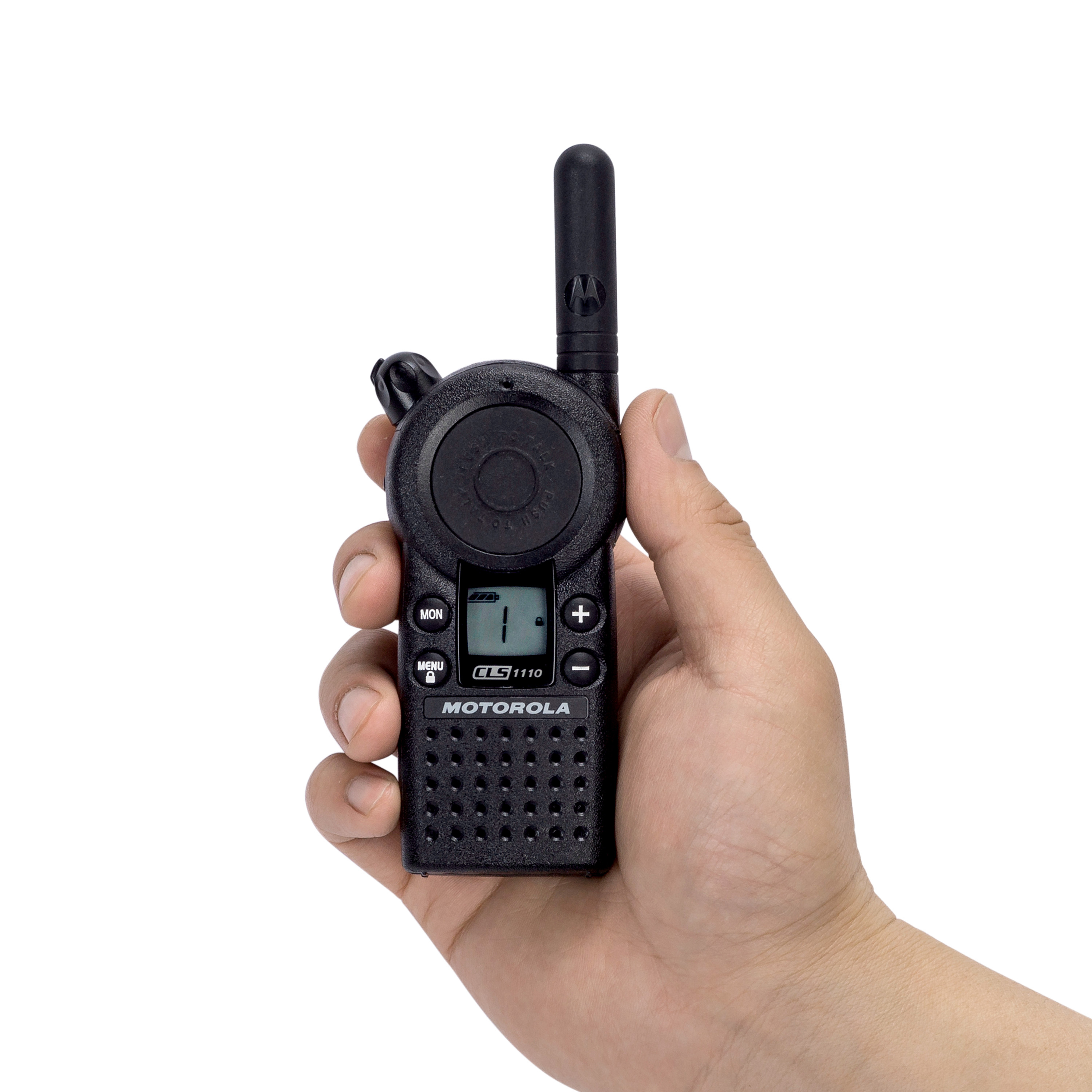
| Specification | Detail |
|---|---|
| Frequency | UHF (460–469 MHz) |
| Power | 1 watt |
| Channels | 4 |
| Indoor Coverage | 200,000 sq ft / up to 15 floors |
| Battery Life | ~10 hours |
| Water Resistance | Splash-resistant (commercial-grade) |
The CLS1410 has been the commercial fitness industry's most widely deployed radio for over a decade. Its four dedicated channels allow a gym to segment front desk, floor trainers, maintenance, and management onto separate communication lines with no overlap. The built-in external speaker—absent from earpiece-only models like the CLPe series—makes it practical for maintenance staff or back-of-house personnel who need to set a radio down on a surface rather than wear an earpiece throughout a shift.
Why it fits gyms specifically
- UHF frequency provides reliable penetration through concrete construction, locker room walls, and mechanical rooms typical of commercial fitness facilities
- Audible Call Alerts with Vibracall technology notify staff even when ambient noise is high
- VOX (voice-activated transmission) allows trainers to communicate without reaching for the radio during a session
- 4 channels support clean role-based segmentation for teams of 4 to 20
- Compact, clip-ready form factor fits a belt or waistband without interfering with physical activity
2. Motorola CLP1010e — Best for Upscale Fitness Studios and Client-Facing Staff
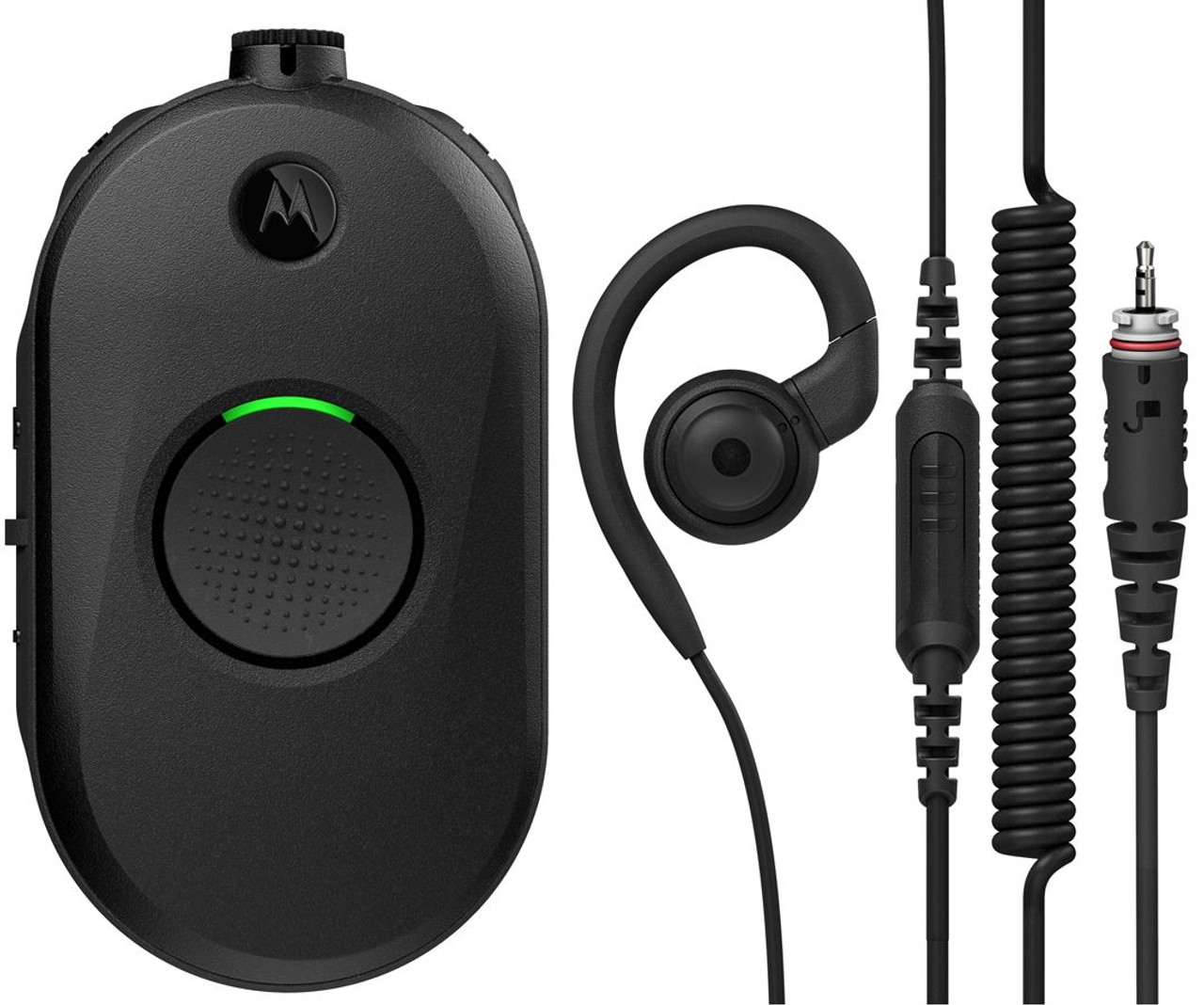
| Specification | Detail |
|---|---|
| Frequency | UHF (450–470 MHz) |
| Power | 1 watt |
| Channels | 1 (upgrade to CLP1080e for 8 channels) |
| Indoor Coverage | 100,000 sq ft / up to 10 floors (up to 20 floors with optional repeater) |
| Battery Life | ~10 hours |
| Form Factor | Under 3 oz., smallest professional radio available |
| Includes | Swivel belt holster and discreet earpiece |
The CLP1010e operates entirely through its included earpiece—there is no external speaker. For premium fitness studios, boutique training facilities, and yoga studios where staff presentation is part of the brand, this is the correct choice. Trainers communicate privately without audible transmissions reaching members on the floor.
Why it fits upscale fitness studios specifically
- Smallest form factor of any professional radio on the market—clips invisibly to athletic wear or a waistband
- Earpiece-only design eliminates audible transmissions in client-facing environments
- Included swivel holster and earpiece require no additional accessories at launch
- UHF frequency maintains signal reliability through multi-room studio layouts and locker room walls
- Under 3 oz. total weight causes no interference with trainer movement or demonstration
Limitation to know: The single-channel base model limits its utility for facilities requiring multi-role channel segmentation. For teams of five or more with distinct roles, start with the CLP1080e, which offers 8 channels in the same form factor.
3. Motorola Curve — Best for Large Fitness Clubs and Multi-Building Facilities
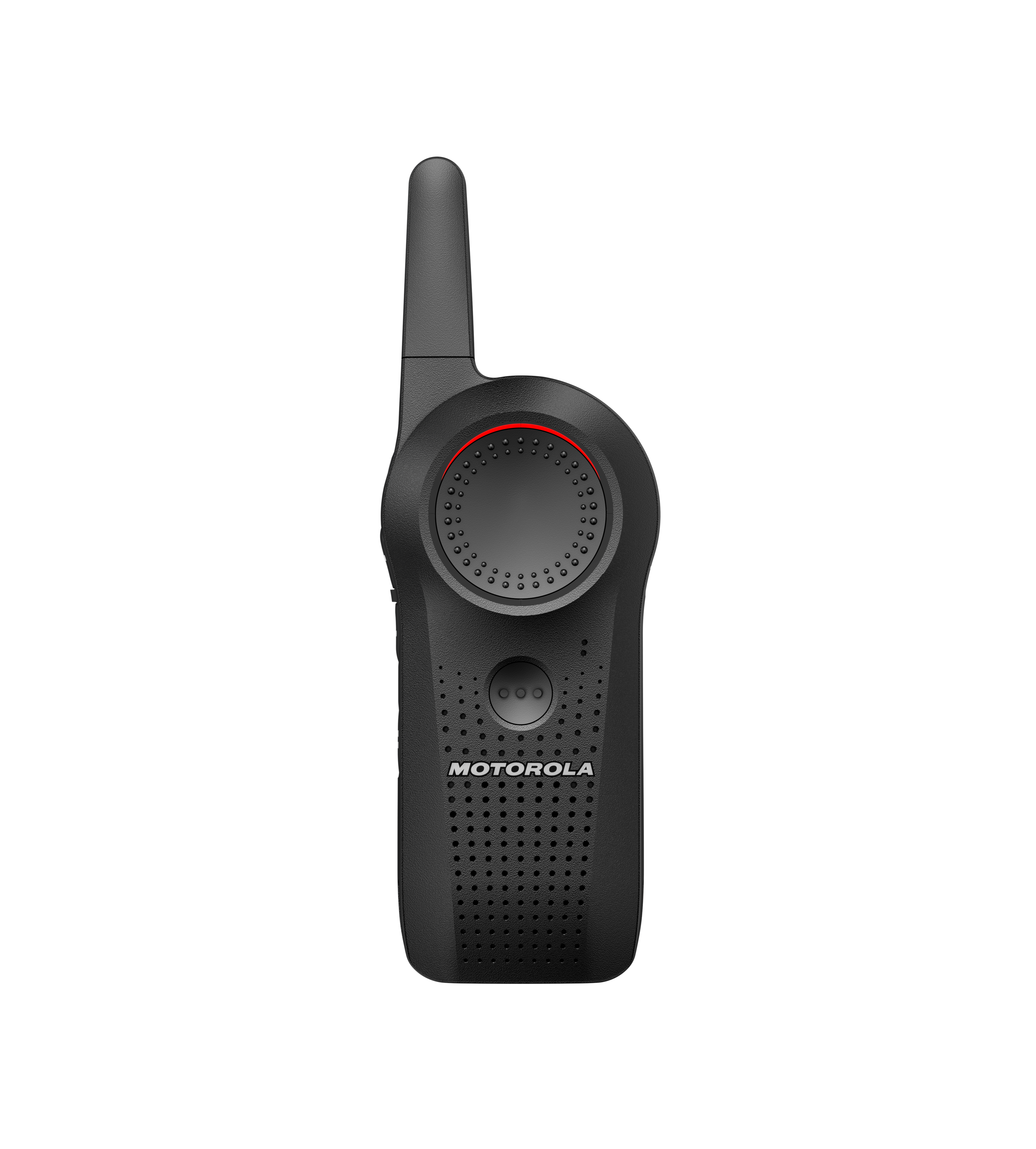
| Specification | Detail |
|---|---|
| Frequency | Digital 900 MHz (902–928 MHz) |
| Power | 1 watt digital (equivalent to ~4 watts analog) |
| Channels | 10 |
| Indoor Coverage | 300,000 sq ft / up to 20 floors |
| Battery Life | ~14 hours |
| Durability | MIL-STD-810 compliant, water-resistant |
| Special Features | Anti-microbial coating, FHSS encryption, Page All / Call All |
The Motorola Curve is the right choice when a facility's square footage, wall construction, or multi-floor layout exceeds what UHF analog radios can reliably serve. Its 900 MHz digital signal penetrates concrete and steel-reinforced construction more effectively than UHF analog at comparable wattage, and its digital equivalent output of approximately 4 watts covers nearly three times the floor area of the CLS1410.
The Curve's anti-microbial coating is a practical specification for gym environments, where radios pass between staff members and are handled by sweating hands throughout the day. Its Frequency Hopping Spread Spectrum (FHSS) technology with 10,000 privacy codes keeps communications private and free from interference in RF-dense environments. The Page All and Call All Available functions allow a manager to reach the entire staff in seconds—critical for emergency response in a large facility.
Why it fits large facilities specifically
- 10 channels support full team segmentation including front desk, floor trainers, group fitness, maintenance, management, and security
- 14-hour battery life covers extended operating hours without mid-shift charging
- MIL-STD-810 compliance handles drops on rubber flooring and exposure to cleaning products
- Digital technology provides clearer audio in RF-dense environments with multiple Bluetooth devices and other radios in use
- Anti-microbial coating addresses hygiene concerns in shared-equipment environments
Also Worth Considering
Motorola CLS1110 — 1 watt, 1 channel, UHF (460–469 MHz), indoor coverage up to 200,000 sq ft / 15 floors. The single-channel version of the CLS series, appropriate for very small gym teams or facilities with a single operational role that needs radio coverage (e.g., maintenance-only deployment).
Kenwood ProTalk PKT-300 — 2 watts, 6 channels, UHF (450–470 MHz), indoor coverage up to 275,000 sq ft. A strong mid-tier alternative for facilities that need six channels and more transmit power than the CLS1410, without moving to a digital platform.
Motorola CLP1080e — 1 watt, 8 channels, UHF (450–470 MHz), indoor coverage up to 100,000 sq ft. The multi-channel version of the CLP earpiece radio, ideal for premium studios with larger staff teams that require channel segmentation alongside a discreet form factor.
Coverage by Facility Size: Matching Radio to Square Footage
| Facility Type | Recommended Radio | Coverage Capacity |
|---|---|---|
| Boutique studio / single floor under 5,000 sq ft | Motorola CLP1010e | 100,000 sq ft |
| Mid-size gym / single or two-floor facility | Motorola CLS1410 or Kenwood PKT-300 | 200,000 - 275,000 sq ft |
| Large fitness club / multi-floor / recreation center | Motorola Curve | Up to 300,000 sq ft / 20 floors |
| Multi-building campus / outdoor facilities | Motorola WAVE PTX (LTE/Wi-Fi) | Unlimited range |
For facilities with poured concrete walls, steel-reinforced construction, or underground levels (common in commercial gym builds), plan for approximately one tier larger than your square footage alone would suggest. Heavy construction absorbs RF signal; the coverage ratings above reflect standard commercial construction.
OSHA Noise Standards and Gym Radio Use
Under OSHA Standard 29 CFR 1910.95, employers must implement a hearing conservation program when workers are exposed to an 8-hour time-weighted average of 85 dB or higher. Group fitness studios running high-volume music, facilities with large cardio equipment floors, and spin or cycling studios can approach or exceed this threshold during peak operational hours.
Two practical implications for gym radio selection: First, earpieces used in high-noise environments should be appropriate for extended wear—the professional earpieces distributed with radios like the CLP1010e are designed for commercial use and are generally appropriate for this context. Second, staff reliance on radio communication in noisy environments reduces the need to shout across a floor to convey operational information, which itself contributes to vocal strain and communication errors over the course of a shift.
OSHA's General Duty Clause (Section 5(a)(1)) also requires employers to address recognized hazards in the workplace. In a fitness facility, member cardiac events, injuries, and equipment failures are documented and foreseeable risks. A reliable internal communication system supports the rapid response those situations require.
Frequently Asked Questions
What is the best two-way radio for a gym?
For most gyms, the Motorola CLS1410 is the strongest all-around choice: four channels, 200,000 sq ft indoor coverage, VOX hands-free capability, and a proven track record in commercial fitness environments. For premium studios where staff appearance and discretion matter, the Motorola CLP1010e is the correct choice. For large multi-floor facilities or those wanting to avoid FCC licensing, the Motorola Curve provides the best coverage and feature set.
How much range does a gym radio need?
For a single-floor gym under 10,000 sq ft with standard commercial construction, a 1-watt UHF radio provides adequate coverage with margin to spare. For multi-floor facilities, buildings with heavy concrete or steel-reinforced construction, or facilities over 50,000 sq ft, plan for 2 watts UHF or a digital radio like the Motorola Curve, which delivers the equivalent of approximately 4 watts analog through its 900 MHz digital signal and covers up to 300,000 sq ft indoors.
How long does the battery last on a gym radio?
Professional radios recommended for gym use carry 10 to 14 hour battery ratings under normal transmission loads. The Motorola Curve leads at approximately 14 hours; the CLS1410 and CLPe series are rated at approximately 10 hours. Motorola and Kenwood commercial-grade batteries are tested to five years of regular field use. For facilities running extended hours or double shifts, multi-unit charging cradles allow battery hot-swapping without downtime.
Are two-way radios water-resistant enough for a gym environment?
The radios recommended on this page carry water-resistance ratings appropriate for gym use, including sweat exposure and cleaning spray contact. The Motorola CLS1410 and CLPe series are rated for water resistance consistent with commercial use. The Motorola Curve meets MIL-STD-810 environmental standards. None of the radios listed are rated for submersion (IPX7 or higher); a gym environment does not require that level of protection under normal operating conditions. For facilities with pools or wet areas, confirm the IP rating before deployment in those zones.
How many channels does a gym need?
A practical starting point for most gyms is four dedicated channels: front desk, floor trainers, maintenance, and management. Facilities with group fitness instructors operating on a separate schedule benefit from a fifth channel. Large clubs with security staff or outdoor components should plan for six to ten channels. The Motorola CLS1410 covers the four-channel case; the Motorola Curve provides ten channels for the most complex team structures.
How many two-way radios does a gym need?
A practical starting point is one radio per key operational role per shift: one per front desk staff member on duty, one per floor trainer, one per group fitness instructor in a class, one for maintenance, and one for the manager on duty. For most small to mid-size gyms, that means four to eight radios. Larger clubs with dedicated security or multiple simultaneous class rooms should scale from peak-hour staffing. Tech Wholesale offers quantity pricing for orders of five or more units—request a quote for current pricing.
Can two-way radios be used for gym emergency response?
Yes, and this is one of the most important use cases for professional radios in fitness facilities. Cardiac events during exercise, member injuries, equipment failures, and unauthorized access all require immediate staff coordination. Dedicated channel assignments allow a trainer to reach the front desk or management instantly without disrupting other operational communication. The Motorola Curve's Page All and Call All Available functions allow a single button press to reach every radio in the facility simultaneously—critical in a medical emergency where every second matters.
What is the difference between analog and digital gym radios?
Analog radios like the CLS1410 and CLPe series operate on traditional UHF frequencies and are the standard choice for most small to mid-size gyms. They are straightforward to deploy, well-supported, and FCC-licensed on standard business frequencies. Digital radios like the Motorola Curve operate on a 900 MHz digital band; 1 watt digital is equivalent to approximately 4 watts analog in effective output, providing significantly better coverage per unit. Digital also provides cleaner audio, better privacy through encryption, and—in the Curve's case—no FCC licensing requirement. For facilities over 50,000 sq ft or with complex multi-floor layouts, digital is typically the better long-term investment.
Why Buy from TechWholesale.com
Tech Wholesale has been selling professional two-way radios to gyms, fitness clubs, recreation centers, and health facilities since 1997. As an authorized dealer for Motorola and Kenwood, every radio we sell carries the full manufacturer warranty—typically two years on commercial-grade models—and qualifies for manufacturer service and repair. There is no gray market inventory, no voided warranties, and no uncertainty about what you are receiving.
What sets us apart
- Lifetime technical support included with every purchase—call or email our team for the life of your radio fleet, not just through the warranty period
- Free quotes for larger teams—request a custom quote
- No-pressure consultation—our team will recommend the right radio for your facility size and team structure, including recommending a less expensive model when it is the appropriate fit
- Free shipping on qualifying orders
- Authorized dealer status—full manufacturer warranty on every unit
If you are not sure which radio fits your gym, use our Find My Radio tool or request a quote. We will ask a few questions about your facility and come back with a specific recommendation.
1-888-925-5982 Service@TechWholesale.com
Related Reading
From TechWholesale.com
- Find My Radio – Interactive Radio Selector
- VOX Feature Explained – Hands-Free Radio Use
- UHF vs VHF – Frequencies Explained
- Privacy Codes – Eliminate Outside Interference
- Frequency Hopping Spread Spectrum (FHSS) Explained
- Two-Way Radio FAQs
External Resources
- OSHA Standard 29 CFR 1910.95 – Occupational Noise Exposure
- FCC Consumer Guide – Two-Way Radios and Licensing
- American College of Sports Medicine – Fitness Facility Standards
Article by Kristin Wood, a two-way radio consultant @ Tech Wholesale | Authorized Motorola & Kenwood Dealer Since 1997 | Last Updated: May 2026